














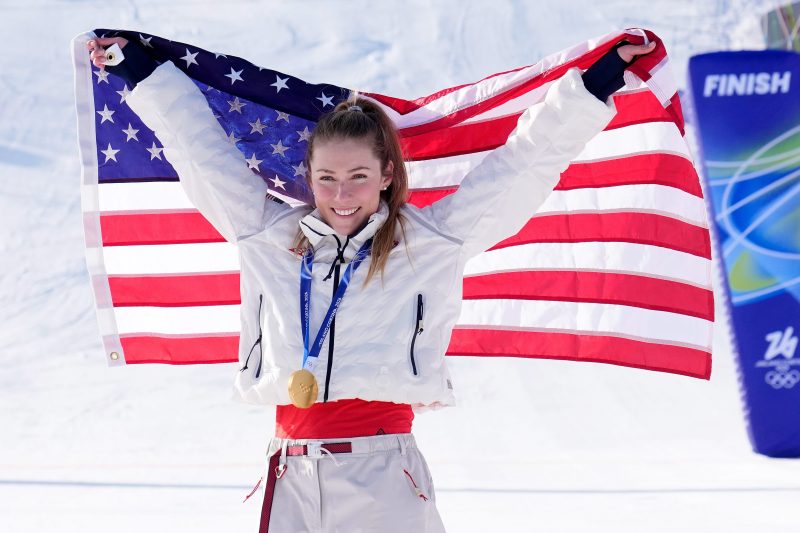
CORTINA D’AMPEZZO, Italy — Take that, haters. Mikaela Shiffrin’s Olympic drought is over.
Shiffrin won gold in the slalom Wednesday, Feb. 18, her first medal since winning a silver in the combined at the 2018 Olympics in Pyeongchang. It snapped an 0-for-8 streak at the Winter Games, which included DNFs in three events four years ago.
‘It’s been so long that I’ve felt tired of questions that don’t feel like they line up with the reality of our sport. And in order to do this today, I kind of needed to accept the possibility that those questions would keep coming,’ Shiffrin said. ‘It was like, just don’t resist it. Just live in my own moment.’
It is Shiffrin’s second gold in the Olympic slalom and third overall, tying her with snowboarder Shaun White and bobsledder Kaillie Humphries for second-most golds by a U.S. Winter Olympian. Speedskaters Bonnie Blair and Eric Heiden each won five golds.
It’s also Shiffrin’s fourth overall Olympic medal, tying her with Julia Mancuso for most by a U.S. woman in Alpine skiing.
‘I have a challenged relationship with racing,’ said Shiffrin, who has always cared far more about the process than the result. ‘But when I get to do it like this today? Actually racing in that way, earning the race, that was wonderful.’
The American women finish the 2026 Milano Cortina Olympics with three Alpine skiing medals, matching their second-most at a single Winter Games. In addition to Shiffrin, Breezy Johnson won gold in the downhill, and Paula Moltzan and Jackie Wiles won bronze in the team combined.
It’s only the second time the U.S. women have claimed two Alpine golds at a single Games. They won golds in the giant slalom and slalom in 1952.
‘Everybody just showed up with so much courage and heart here, and I’m so proud to be part of this American team,’ Shiffrin said.
Shiffrin finished with a combined time of 1:39.10, 1.5 seconds ahead of Switzerland’s Camille Rast, who took silver, and 1.71 seconds ahead of Sweden’s Anna Swenn Larsson, who got bronze.
The gold was all but assured after Shiffrin’s blistering first run, which gave her a lead of 0.82 seconds over Germany’s Lena Duerr. To put in perspective how commanding that was, there was as much distance between Shiffrin and Duerr as there was between Duerr and Austria’s Katharina Truppe, who was 10th.
‘I knew Mikaela could ski rally fast on this kind of slope and I need to push really hard to beat her on this kind of slope,’ Rast said. ‘After the first run, I knew gold was gone but silver and bronze were open.’
This is the kind of dominance Shiffrin has shown week after week on the World Cup circuit, where she’s won seven of the first eight slaloms and been second in the other. She’s been so in command she wrapped up her ninth season slalom title before the Olympics.
But when Shiffrin struggled in the slalom portion of the team combined on Feb. 10, finishing 15th out of 18 skiers and dropping her and Breezy Johnson from first to fourth, it raised questions about whether the Olympics had become a mental hurdle following her struggles in the 2022 Beijing Games.
Shiffrin has more World Cup wins (108) and podiums (166) than any other skier, male or female, and she’s been in the top three in more than 55% of her starts. She’s the only skier in history to win a World Cup in each of skiing’s six disciplines – downhill, super-G, giant slalom, slalom, combined and parallel – and she has the single-season record for wins with 17.
Shiffrin also has three Olympic medals, two of them gold, won in her first two Winter Games.
Which is what made Beijing so out of character. Shiffrin didn’t finish a single tech run in an individual race. Her best individual result was ninth in the super-G.
But Shiffrin looked better in the giant slalom here, finishing 0.30 seconds off the podium. Afterward, she sounded optimistic about the upcoming slalom race.
“After the team combined, I went out and did a really wonderful session of training with my team, focusing on some of those variables that were really destabilizing,” Shiffrin said after the GS race.
‘No matter how many runs of slalom I do, it never gets easier. It only gets — you become more aware of how challenging it is,’ she added. ‘But it felt really good. It was great to practice and sort of take control of that.’
That carried over to race day.
When Shiffrin is on, she skis with a deceptive effortlessness. While other skiers seem to lunge from gate to gate, she flows. It’s not until you look at the splits, or her final time, that you realize how aggressively she’s been skiing to produce that kind of speed.
That was the case in the first run, when she came out blazing and never backed off. She had the fastest times in three of the four sections of the course, and was just 0.03 seconds off the pace in the other. When she crossed the finish line, she gave a pump of her fist.
It was more of the same in the second run.
‘Both runs were exactly what I wanted to feel overall,’ Shiffrin said. ‘Every time you get a little disturbance in the ski, just dive down into it more. And oftentimes I get through the finish and I’m just like, thank you for letting that work.’
Work it did. And now the haters will have to find someone else to criticize.