


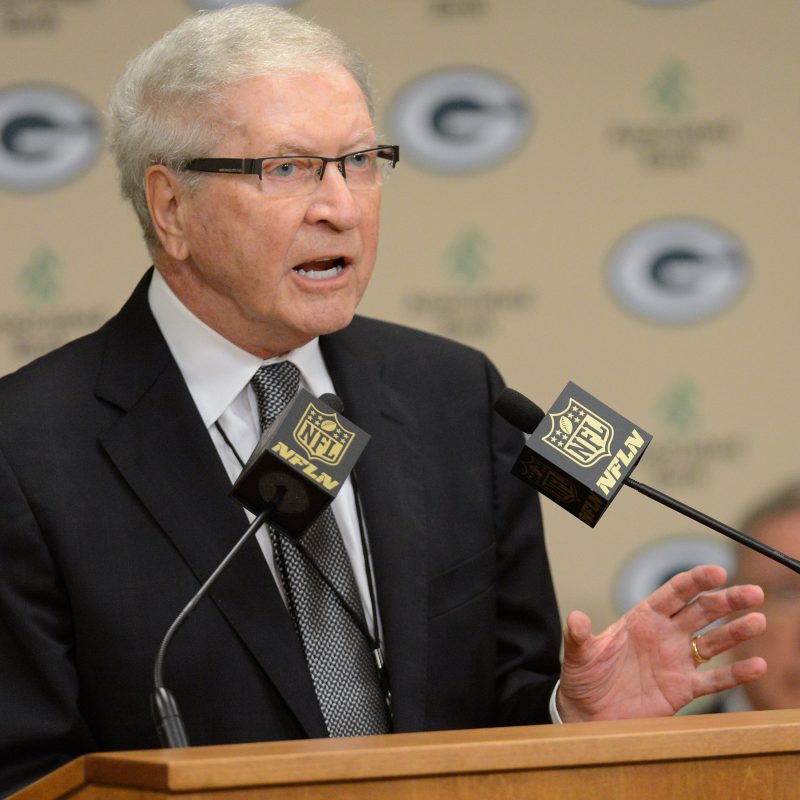
Former Green Bay Packers President and CEO Bob Harlan died at the age of 89.
Harlan’s key decisions included hiring GM Ron Wolf and spearheading the Lambeau Field renovation.
He is credited with remaking the franchise and setting it up for decades of success.
Harlan also made the tough call to end the tradition of playing home games in Milwaukee.
GREEN BAY, WI − Bob Harlan was the architect of today’s Green Bay Packers. His decisions during 18½ years as leader of the organization remade the franchise on and off the field.
Robert E. “Bob” Harlan died March 5 at age 89 at St. Mary’s Hospital in Green Bay.
He came across as an avuncular friend to everyone, but behind the genial façade was a leader who did not hesitate to make hard decisions, such as when he decided the team would no longer play games in Milwaukee, decided at the last minute that John Jones should not lead the organization because of medical reasons, and stripped general manager and head coach Mike Sherman of his GM duties.
His most controversial move was to seek a 0.5% Brown County-only sales tax to renovate Lambeau Field. The project, completed in 2003, made the Packers one of the NFL’s elite franchises on and off the field.
Before that, his decision in 1991 to give general manager Ron Wolf control of football operations led to two Super Bowl appearances and one victory, and set the model for football operations for 27 years, during which the Packers were one of the most successful teams in the NFL.
Harlan joined the Packers on June 1, 1971, as a player-contract negotiator after six years with the World Series-winning St. Louis Cardinals. Before that he was sports information director for his alma mater, Marquette University in Milwaukee, which included one year with legendary coach Al McGuire. Harlan might be the only person to have both World Series and Super Bowl championship rings.
Harlan’s duties with the Packers increased year to year until he was named president and CEO on June 5, 1989. His first significant move was to fire Tom Braatz in mid-season in 1991 and hire Wolf as general manager and undisputed head of football operations.
Wolf hired Mike Holmgren as coach, traded for Brett Favre and signed free agent Reggie White.
The team won a Super Bowl in 1997 and lost one in ’98. The Packers were 261-154-1, a 63% winning percentage, from 1992-2017.
“The Packers family was saddened to learn of the passing of Bob Harlan,” Packers president and CEO Ed Policy said in a release. “Bob was a visionary leader whose impact on the franchise was transformational. From his inspired hiring of Ron Wolf to turn around the club’s on-field fortunes to his tireless work to redevelop Lambeau Field, Bob restored the Packers to competitive excellence during his tenure and helped ensure our unique and treasured flagship NFL franchise was on sound footing for sustained generational success.
“We send our deepest sympathies to his wife, Madeline, and the entire Harlan family.”
Tom Murphy, vice president and former archivist for the Green Bay Packers Hall of Fame, said Harlan would be near the top of his list for most influential Packers executives.
“Bob Harlan and Ron Wolf have to be right up there with Lambeau and Lombardi,” he said. “I don’t know why he’s not in the Pro Football Hall of Fame.”
Murphy said Harlan’s hiring of Wolf and his work in getting the sales tax passed for the 2003 renovation of Lambeau Field were among the most important actions in franchise history.
“He did that, probably, at the peril of his own health. He was under great pressure and that was a pretty close vote,” Murphy said.
Harlan said in his 2007 memoir, “Green and Golden Moments, Bob Harlan and the Green Bay Packers,” that winning the 1997 Super Bowl was his proudest football moment “because even some diehard Packers fans in the late ‘80s and early ‘90s thought it was never going to happen again.”
Harlan was humble and self-effacing, but anyone who misread that for softness was badly mistaken. Professionally, Harlan always made the best interests of the Green Bay Packers a priority. He made the tough decisions, probably none more difficult than his last-minute decision to recommend that John Jones, his chosen successor as Packers president, be replaced for health reasons.
In June 2006, Jones underwent heart surgery to correct a dissected aorta, during which he suffered a stroke that affected his short-term memory and physical stamina.
The Packers made Mark Murphy president and CEO, instead, after asking Harlan to remain at the helm for one year beyond the mandatory retirement age of 70.
Harlan said his greatest accomplishments were hiring Wolf and Ted Thompson as general managers and passing the Lambeau Field renovation sales tax.
“People talk about a window of opportunity for a football team to succeed,” he wrote in his memoir. “Well, we had a window of opportunity to get the stadium done. I think God tapped me on the shoulder one day and said, ‘You’d better do it right now and get it over with.’ And we did. Now it’s in place for the future, and we can move forward. If we didn’t have the stadium, there wouldn’t be a future.”
Harlan said passing the 0.5% sales tax to pay for the 2003 renovation of Lambeau field saved the Packers, but it was also the hardest thing he’d ever done. So hard, he started his memoir talking about how his wife, Madeline, told him to stop reading letters to the editor on the subject. In that regard, he was fortunate that window opened before the advent of social media.
Harlan said the referendum campaign, which the Packers won with 53% of the vote, was a nightmare.
“… you can’t imagine how bad a nightmare it is until you live through it. People kept saying to me, ‘Bob, you’re the only one who can win this for us.’
“And I kept thinking, ‘Well, if we lose it, I’m also the guy who’s going to lose it for the franchise.’ That weighed on me a great deal.”
He also directed the Packers fourth-ever stock sale in 1997, which aided in the 2003 renovation.
Because of that renovation, the Packers could expand Lambeau Field and launch the Titletown District, the total of which cost more than the 2003 renovation and was done without taxpayer dollars.
Harlan was born in Des Moines, Iowa, on Sept. 9, 1936. His father, Sy Harlan, was the president of a trucking company, but died at age 56. Harlan said his mother, Alice, was a huge influence in his life because his dad traveled a lot and she was the one guiding his upbringing.
Harlan was a tough character when he needed to be, but when his mother died in 2000, he was unwilling to return to his family home, as his wife Madeline explained in his book.
“He was exceptionally close to his mother. Whereas his father was extremely successful and someone to emulate, his mother was probably the one who had more to do with forming his values,” she wrote. “Then there was the selling of her house after the funeral. Bob never went back to that house.”
Harlan was known for personally answering his phone at Lambeau Field and returning all calls, especially if they were from fans or stockholders. Those calls often enough resulted in Harlan getting an earful about something the Packers allegedly were doing wrong, but he believed it was his responsibility to hear them out.
“When I talk to one fan there’s a good chance that he’ll go tell 20 other people about it,” Harlan wrote. “So I’m not just talking to one fan, I’m talking to 21 … Public relations is very important to the Green Bay Packers, and there’s never going to be a day when it’s not important.”
Harlan made the decision to play all Packers home games at Lambeau Field, after three regular-season games were played in Milwaukee for decades. He worked on the plan alone for months before he started telling people, including his own executive committee. Harlan said it was a hard decision, but came off with much less controversy than he expected.
When Harlan made decisions, he often did so on his own. He said that when he took a decision to the executive board, he looked for its support, not its permission.
Harlan, by nature and position as Packers president, could be persuasive. When he appointed his first new executive committee members in 11 years, the Packers suggested the new members would be available for interviews. One of them, however, had a long-running dispute with the Press-Gazette and vowed to never again talk to its reporters, a position he maintained for four years. Harlan said he’d take care of it, and he did. The interview was done, without rancor, and that board member ever after was a good source and available for interviews.
In his book, Harlan made the astounding claim at the beginning of one chapter that he never paid for a ticket to a Green Bay Packers game, even when he was in college at Marquette University. He would sneak through a hole in the fence at County Stadium in Milwaukee and once in Green Bay placed himself in the middle of a group of people and just walked into the stadium.
After retiring from the Packers, Harlan served on the board of directors of the Green Bay Packers Hall of Fame.
Harlan is survived by his wife, Madeline, and three sons, Kevin, Mike and Bryan. Kevin is an award-winning sports broadcaster, and granddaughter Olivia Harlan Dekker is a college and NFL reporter.