







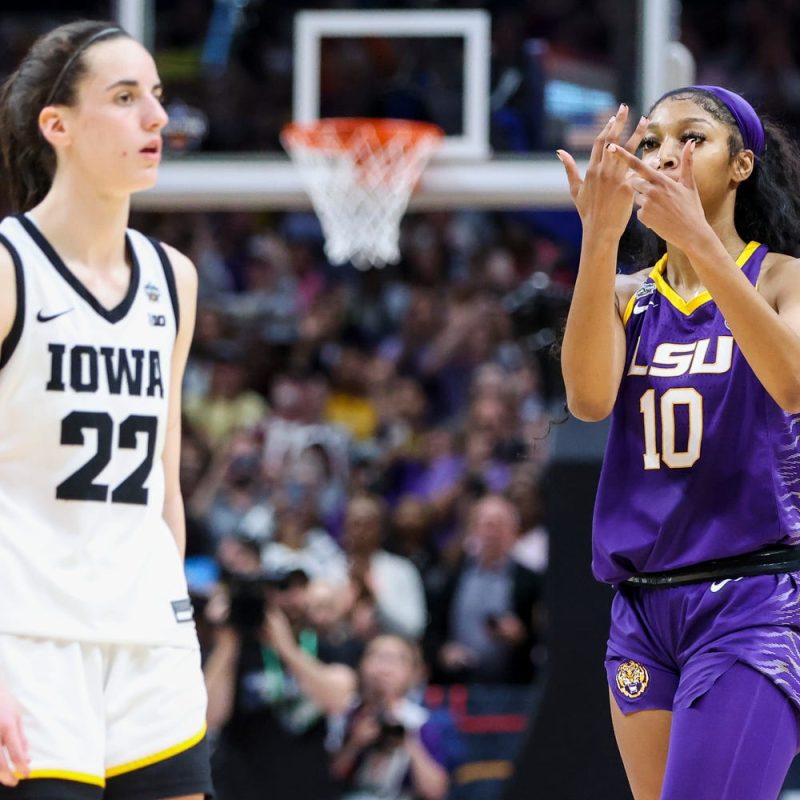
In January LSU’s Angel Reese tweeted something that would turn out to be almost prescient, and came into play months later when the Tigers would beat Iowa for the women’s national championship.
‘I’m too hood. I’m too ghetto,’ she tweeted. ‘I don’t fit the narrative and I’m OK with that. I’m from Baltimore where you hoop outside and talk trash. If it was a boy y’all wouldn’t be saying nun at all. Let’s normalize women showing passion for the game instead of it being ’embarrassing.”
As someone who played a lot of basketball (badly) all across Baltimore while in high school, this is correct. But also, at pickup games anywhere in the country, everyone talks trash: Black, white, Latino, Asian, Vulcan, Klingon, everyone.
Months later, after the championship game win on Sunday night, Reese doubled down, and justifiably added the explosive primordial molecule of race, in what was one of the finest moments of a remarkable tournament, and an example of Black fearlessness and strength.
‘I don’t fit the narrative. I don’t fit the box that y’all want me to be in,’ she said postgame on Sunday night. ”I’m too hood. I’m too ghetto.’ Y’all told me that all year. When other people do it, y’all don’t say nothing. This was for the people that look like me.’
To be clear, when Reese says ‘other people’ she means white people. And she is correct about that double standard.
It was in play throughout this tournament when it came to Caitlin Clark, one of the most talented and entertaining players in the history of college basketball. Clark is a skilled trash talker and used the John Cena ‘you can’t see me’ taunt multiple times throughout the tournament. In the closing moment of the championship game, Reese did the same taunt and also pointed to her hand, signaling she was getting a championship ring.
It’s true that Reese escalated the trash talk by walking behind Clark while taunting her, the action still didn’t come close to justifying the massive amount of vitriol aimed at her on social media. The situation seemed divided by race, with many Black people (not all) defending Reese, and many white people (not all) criticizing her.
To show just how big a story this became, how it divided along racial lines, after a famous white former sports broadcaster called Reese a ‘(expletive) idiot,’ actor Samuel L. Jackson tweeted to his nine million followers a spirited defense of Reese that can’t be printed here. LeBron James backed Reese as well.
This game, and other moments in the women’s tournament, as great as it was, as magical as it was for LSU, also exposed some long, ugly stereotypes about Black people that refuse to die. The stereotypes go like this:
When Black players are aggressive, and talk trash, they are thugs and animals.
When white players are aggressive, and talk trash, they are passionate and fiery.
This stereotype goes back decades. Larry Bird was the greatest trash talker of all time but was celebrated for his passion. Tom Brady screamed at teammates and coaches and was viewed as scrappy. John Thompson’s Georgetown Hoyas, who played defense with spirit and ferocity, were called thugs. Fights in hockey is seen as tradition. Fights in NASCAR is seen as cool and spirited. Fights in NBA games lead to white commentators asking: ‘Where are the fathers?’
There’s a reason why so many Black athletes came to the defense of Reese because so many have seen and faced this double standard themselves.
Washington Mystics player Natasha Cloud tweeted: ‘This is where we need our allies. I would love for our white counterparts who play to step up and say what it is. There’s a difference in how we perceive white and Black players passion for the game.’
‘White players are ‘passionate’ and ‘competitive.’ Black players are ‘classless thugs.’ It’s reckless narratives that continue to divide us,’ she added.
South Carolina coach Dawn Staley, after the team’s Final Four loss to Iowa, spoke about fighting the stereotype that her team is thuggish because they play with physicality. The language being used to describe them by some is reminiscent of the things that were once said about Thompson’s Hoyas.
‘We’re not bar fighters. We’re not thugs. We’re not monkeys. We’re not street fighters,’ Staley said. ‘I do think that that’s sometimes brought into the game, and it hurts.’
Again, these stereotypes are potent and refuse to die. They are the dinosaurs of racism but haven’t gone extinct.
Author and college professor David J. Leonard wrote about whiteness in sports culture in the book Playing While White: Privilege and Power on and off the Field.
‘To be a white athlete is to be a scrappy and gritty player, whose motor never stops, whose ‘drive never relents’ and whose determination is unmatched,’ he wrote in an adaptation of his book for The Undefeated. ‘To be a white athlete is to ‘play the right way,’ to be unselfish, to be without ego and to always put winning and team first and foremost. These sorts of racially stratified descriptors are common in the sports media, from coaches and general managers, and from fans alike. As are the consistent attribution of hard work and intelligence to white athletes whose IQs, work ethic and intangibles are the source of constant celebration. To be a white athlete is to be cerebral, a student of the game, a throwback to a different era.
‘The power of whiteness is equally evident in the trash talk of John Stockton, Larry Bird, Brady and (Johnny) Manziel. Amid widespread nostalgia for greater sportsmanship and respect for the game, whereupon hip-hop and black athletes are blamed for the intrusion of toxic values, the trash-talking of white athletes is either ignored or celebrated as evidence of their passion for the game and competitiveness.’
Clark is one of the crown jewels of college basketball and she will talk her trash and wave her hand, as she should. She can back up the talk with beautiful play.
There will be Black players who will talk their trash, too. Hopefully the standard they’re held to won’t be different from Clark’s.